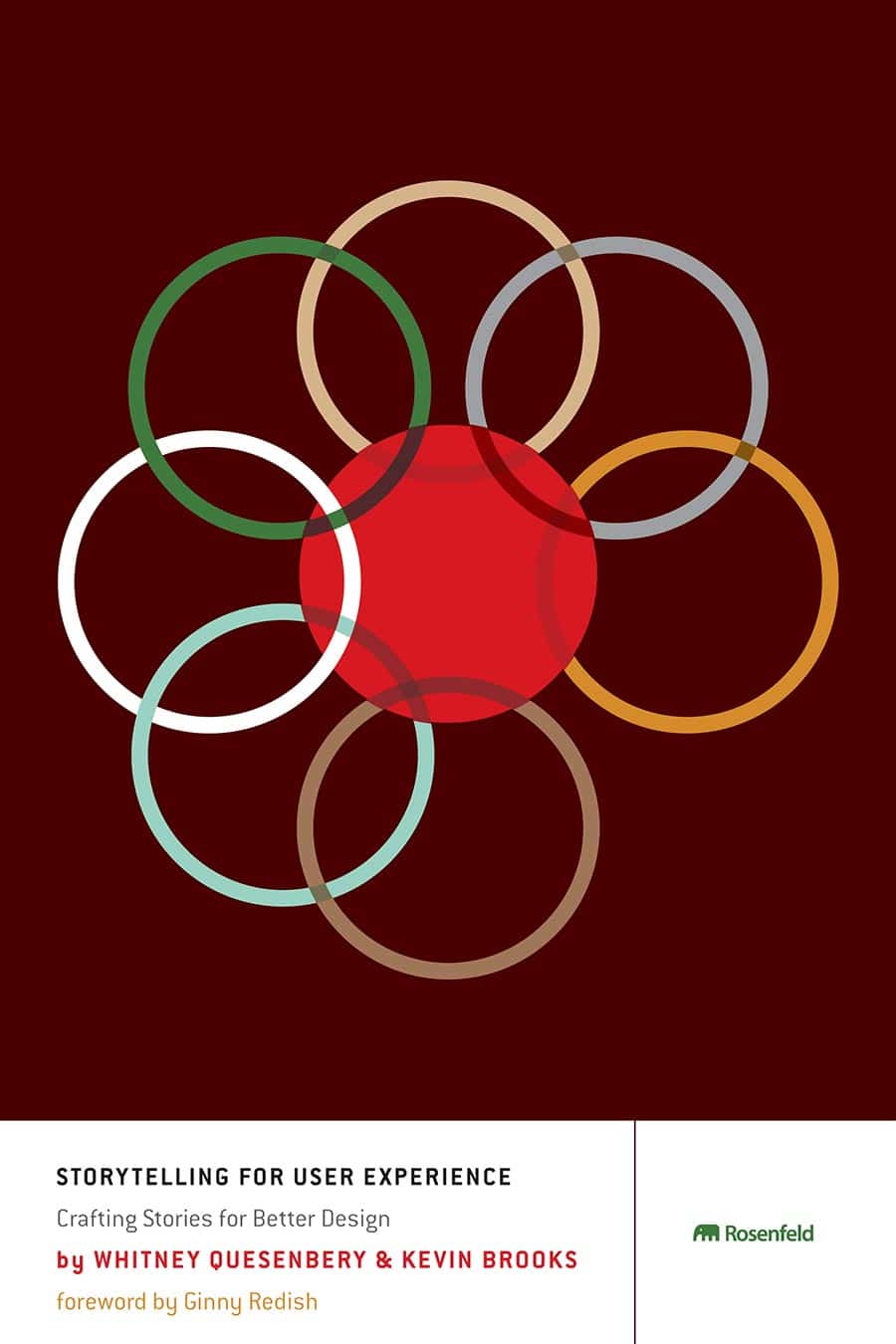


Storytelling for User Experience

Crafting Stories for Better Design
We all use stories to communicate, explore, persuade, and inspire. In user experience, stories help us to understand our users, learn about their goals, explain our research, and demonstrate our design ideas. In this book, Quesenbery and Brooks teach you how to craft and tell your own unique stories to improve your designs.
We all use stories to communicate, explore, persuade, and inspire. In user experience, stories help us to understand our users, learn about their goals, explain our research, and demonstrate our design ideas. In this book, Quesenbery and Brooks teach you how to craft and tell your own unique stories to improve your designs.
Testimonials
Storytelling has always been a critical part of human communication. And, it has often played some part in designing human-computer systems. As the scope of human computer systems continues to increase to new form factors, social contexts, and cultures, storytelling techniques are becoming ever more important throughout the design and development process. In Storytelling for User Experience, the authors present the User Experience practitioner a wide range of useful techniques and advice about storytelling. The book is liberally sprinkled with material taken from real world cases both from their own experience and from that of other practitioners. It is quite readable and should prove extremely valuable for anyone interested in making products that are actually useful and usable.
John C Thomas, Ph.D., IBM T. J. Watson Research Center
Stories facilitate a level of communication that is as close to telepathy as you can get. Kevin and Whitney guide you to use storytelling in `how to’ scenarios so smoothly that you may never realize how far you leapfrogged ahead and never know the mistakes you didn’t make because of this book. It’s that good.
Annette Simmons, author of The Story Factor
For more than two decades I’ve taught that usability is the key to creating an accessible user experience for people with disabilities. However, Whitney and Kevin have opened my eyes to the incredible power of storytelling; how communicating user needs combined with empathic listening is the bridge that closes the gap between software design and accessibility. Storytelling creates the light bulb moment that says, `Ahhh…Now I understand.’ And that is what everyone wants—to be understood.
Mike Paciello, The Paciello Group
A very practical, readable survey of ways to use one of the world’s oldest and most powerful transmedia forms—storytelling—to increase the coherence and effectiveness of digital artifacts. Brooks and Quesenbery offer concrete strategies for creating a richer design process and more successful user experiences.
Janet Murray, Director of Graduate Studies, Digital Media M.S./Ph.D. Program, Georgia Tech
Storytelling is as old as humanity. We seem to have forgotten this communication art, its wisdom, and its pleasure, in an era of action-movies with mindless superheroes and heroines. Quesenbery and Brooks help us to remember the power of effective and affective storytelling in all phases of product/service development, from research and analysis, to design and evaluation. All the roads of storytelling lead to better understanding of oneself, of users, of stakeholders in the success of the user experience. This useful and innovative book treats the key components of good storytelling in developing user experiences and provides smart, focused advice for putting techniques into practice.
Aaron Marcus, President, Aaron Marcus and Associates,Inc. and Editor-in-Chief Emeritus, User Experience
This book fills a gap that I didn’t know existed until I read it! Clearly, we are engaged in story telling as part of exploring, understanding, and bringing alive the user and the user’s experience. With this book, we can now add, if we aren’t doing this already, this tool to our UX toolkit. Going beyond the concept of personas and use cases, storytelling, as the authors illustrate so well in the book, can be applied to any part of the design and development of the product: from conception through birth and beyond.
Carol M. Barnum, Director, Usability Center and Director, Graduate programs in Information Design and Communication, Southern Polytechnic State University
I have been tantalized by the power of the story to impact so many facets of the user experience process. The arrival of this thoughtful, actionable, and wide-ranging book is a glorious day!
Steve Portigal, Principal, Portigal Consulting
Whitney and Kevin clearly articulate the power and effectiveness of storytelling for understanding users and communicating their real experiences to all project stakeholders. Their guidelines for integrating storytelling into user research and design have already given me new ways to help my clients better know their users and deliver great products and services. This is a reference I will be reaching for regularly.
Karen Bachmann, Partner, Seascape Consulting
The user’s experience is not confined to a single point in time, but is built up over many moments and contexts. Designers must be able to explore this continuum, and return with information that helps design teams, and entire organisations, build better products and services. Most of us know the power of the story, but we may not appreciate how applicable story-telling can be to the work of the designer—in understanding users, communicating with business stakeholders, and in envisioning and creating. Read this book, and put the power of the story to work for your projects.
Gerry Gaffney, Director of Information & Design (www.infodesign.com.au) and producer of the User Experience podcast (www.uxpod.com)
Table of Contents
Foreword by Janice (Ginny) Redish
Chapter 1: Why Stories?
Chapter 2: How UX Stories Work
Chapter 3: Stories Start with Listening (and Observing)
Chapter 4: The Ethics of Stories
Chapter 5: Stories as Part of a UX Process
Chapter 6: Collecting Stories (as Part of Research)
Chapter 7: Selecting Stories (as Part of Analysis)
Chapter 8: Using Stories for Design Ideas
Chapter 9: Evaluating with Stories
Chapter 10: Sharing Stories (Managing Up and Across
Chapter 11: Crafting a Story
Chapter 12: Considering the Audience
Chapter 13: Combining the Ingredients of a Story
Chapter 14: Developing Structure and Plot
Chapter 15: Ways to Tell Stories
Chapter 16 Try Something New
FAQ
These common questions about storytelling and their short answers are taken from Kevin Brooks & Whitney Quesenbery’s book Storytelling for User Experience. You can find longer answers to each in your copy of the book, either printed or digital version.
- Why stories in user experience design?
Stories have always been part of user experience design as scenarios, storyboard, flow charts, personas, and every other technique that we use to communicate how (and why) a new design will work. As a part of user experience design, stories serve to ground the work in a real context by connecting design ideas to the people who will use the product. This book starts with a look at how and why stories are so effective.
See Chapters 1 and 2.