
Skip to Navigation | Skip to Content

Mental Models

Aligning design strategy with human behavior

Mental Models

Support Intentions, Not Existing Workflows

This week I was chatting with someone who works at an organization that does not yet recognize the value of generative research before defining products. She said to me, with exasperation in her voice, "The product managers here still go around collecting needs from our customers and giving us lists of features to implement." She had some money left over from a budget (that doesn't happen often!) and wanted to spend it on a small research project that would get to the root of what people were trying to do--people who were not yet customers. Her dream is to be able to show the product managers and executives at her company results from the generative research illuminating several new, previously uncharted activities that her company can support.

Her situation got me thinking about how most organizations go about product design, and how short-sighted their method is. Usually the focus is on existing practices of customers using existing products. If you're lucky, maybe the focus is on existing practices, but of people using other companies' products. People spend lots of effort to capture the step-by-step procedure customers use to achieve something. They produce a lot of boxes-and-arrows diagrams that portray all the nuances of the customer process. A lot of time and sweat is invested in making those boxes-and-arrows precise, which is unnecessary, in my opinion. If the precise diagram only traces the workaround someone developed to make things go how he wants them to go, then you are only perpetuating a flaw. Sure, people buy flawed services and products, but not because they want to. It's because it's all the choice they have.

It's time to go past the existing workflow and get into peoples' intentions.

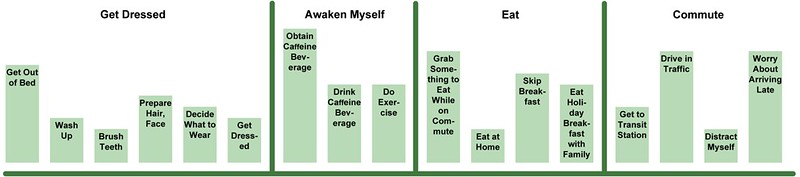
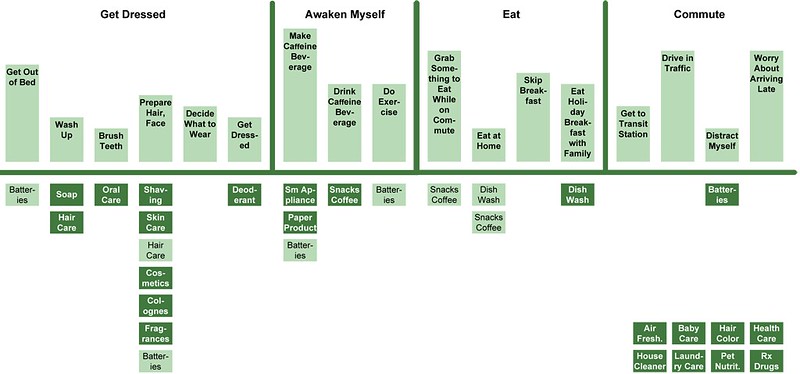
Examples of steps in a workflow versus the intention behind them

In each of these examples, you can imagine different ways to support the actor. Take the hungry person who just wants to spend time with her husband after their very busy days. Cooking and shopping are just two things she can eliminate from her schedule. She could also eliminate picking up the dry cleaning or writing checks to pay bills. But let's say your organization is an organic produce farmers market. You have a basic philosophy of helping people eat healthy foods. You offer a weekly home-delivery service of a box of local, in-season fruit and vegetables. Along with that service, you have a selection of recipes online to help people cook vegetables they are unfamiliar with. For years you and your peers have been discussing how to convince people to stop doing the fast food thing, but the ease of getting quick, cheap (usually sweet and fatty and produced somewhere far, far away--but I digress) food seems like too much to overcome. Examine her underlying motive: spend more time with her husband. Let's say that you've already captured the market that happily cooks and have convinced their spouses to cook together. That leaves the couple that doesn't like cooking. What if you get a professional kitchen license and create some simple, wholesome, organic "TV dinners," packaged in recyclable paper take-out boxes, that you offer for weekly delivery. True, this is a business risk and probably costs almost as much to produce as you could charge for it, but it is worth exploring since you already have the delivery infrastructure in place. If the hungry person is motivated more by quality time than by cost, then you might have a great idea here.

When you spend time with people who might become someone you produce a service or a product for, concentrate on finding these underlying intentions. Deliberately jump past the details of how they execute something currently and spend time instead asking them what's behind this step. What are they trying to accomplish besides the step itself? Frequently, people haven't really thought past the steps, and your conversation turns into more of a psychotherapy session, helping the person work through the underlying issues and describe them for you. When this happens, you know you're on the right track. With the results of several conversations like this, you can guide your organization into areas you hadn't previously considered or been consciously aware of. This direction leads to services and products that support what a person really intends to do and makes their life smoother. And that is a very attractive proposition to most of us.

Comments

Hi Indi,

You make some very good points in this post that I agree with. Uncovering intentions is going to give you the most insight into opportunities for how a business can help its customers with services and solutions.

I'm not sure, however, if I'd recommend to "jump past the details" of task-level workflow analysis. In many cases, that is also important.

At my company we're starting a program of detailed workflow mapping. Many people inside the business don't know precisely what our customers do (not necessarily with our products, but in general). Internally, we may also have different impressions of customer workflow. So we've found detailed workflow mapping to be a good tool to slow down our collective thinking and go through things step by step so we all have the same picture in our heads.

At the same time, we're trying to include levels of abstraction to the task-based workflows to include things like goals and motiviations--the intentions you speak of. So we actually end up with a hierarchy of analysis: tasks, goals, and intentions.

I guess the point is, you probably need all of those types of information. If I, for instance, went into a meeting to present findings of a user study with only intentions, it would be too abstract for most of my audiences. Also, sometimes you as a researcher need to go through the detailed task analysis before even being able to arrive a valid intentions.

Thanks.

James, thanks for writing! Yes, detailed workflow is important and acts as a concrete basis for stakeholders to grip, but I would suggest (to most practitioners) doing that level of analysis *after* doing the analysis of intentions. That way you can see clearly what parts of the workflow are "made up" (so to speak) to get around barriers presented by (lack of) tools, politics, conflicting business rules, confusion, communication issues, etc. I would just put one before the other, or at least have separate teams do each project. The existing workflow is something you can then slot beneath the towers of intentions & behaviors in the mental model. I have seen much gray hair and angst when a single team tries to do both types of analysis at once. If schedules dictate parallel work, assign each project to different people. If you don't have enough resources to do parallel work, make the mental model first. The workflow analysis tends to make our minds fall into the ruts of the business rules, after which it is more difficult to take a whole new perspective on things by looking at intentions. (Grin! Of course, your mind is perfectly capable of keeping the two separate! I just don't recommend it for everyone. ;) And of course I wanted to write a title that could clarify the distinction. ;)

Hi Indi,

Great points. What you are speaking to is one of the most interesting (and promising I feel) bridges we as Experience Designers need to cross: being viewed as Business Analysts that focus on Experience. The 'traditional' box and arrows of process and workflow, requirements gathering, etc, often fall to the BA on a project. And I think it's safe to say that, compared to UX/XD, the BA role is widely recognized and valued. This of course stands to reason as they tend to serve two legs of a 3 legged stool - the Business (Process) and IT (Technology) groups within an organization. We Experience Design folks, on the other hand, are serving that often overlooked leg in the stool, the audience.

One way that I've been trying to encapsulate this idea of getting audience intention integrated into product design, SDLC's, etc. is to explain our role as the same as Business Analysts, but simply from a different perspective. Defining "As-Is" and "To-Be" processing, requirments gathering, interviewing key stakeholders... all the things that are typically ascribed to BAs are in fact what we do as well. There's a simple difference I feel we haven't really done a great job explaining. Whereas BA's 'start' from Biz/IT, we start from the audience. As James suggests and you agree, by working towards interlocking the known, traditional and trusted means of product design, and explaining it that way (as opposed to 'doing it a different way'), the chances of getting teams on board with audience research increases significantly.

Thanks Indi!
Ronnie

The holidays have one thing that's positive: they give people a little extra time to think through things. James Kalbach used this time to great advantage offering a thoughtful post in response to Don Norman's claims that design research is useless when it comes to innovation. When I read Don's piece a few weeks ago it had the tone of an emotional reaction, but I didn't understand the background. James' post does a better job exploring the arena of innovation and design research.

Hi Indi,
Firstly, I'm totally in league with the comments here: it's also helped my thinking around Mental Modelling.
I couldn't help reading on to James' and then Don's points of view. I think Don acknowledges how we can improve or change offerings with research; he just wanted to clarify on innovation via invention and what effect that can have regardless of business decisions or products.
I do wish he had expanded on invention though - it really does require research: understanding what has gone before (success and failures), incorporating other peoples innovations and a vision or dream for future use. Wozniak's Apple II is a great example, it required all of this as well as a passion for invention.

Post a comment

We’ve enabled comment moderation on Rosenfeld Media. Upon posting your comment, it will not immediately appear on this page. Hang tight, we’ll be sure to screen it before too long. (Starred fields are required)

We don’t like these either (but comment spam makes them a must)

Buy This Book:

Format & Ordering Info