

Should I Call It a Mental Model?
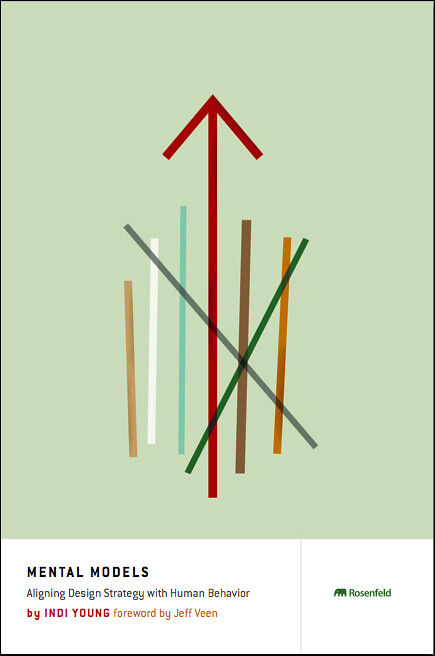
I've gotten a lot of feedback about the title "Alignment Diagrams." I am keeping a tally. Six people have said they like it, nine people have good reasons for me to continue calling it "mental model," and nine people would rather I use a different name altogether. What do you think?
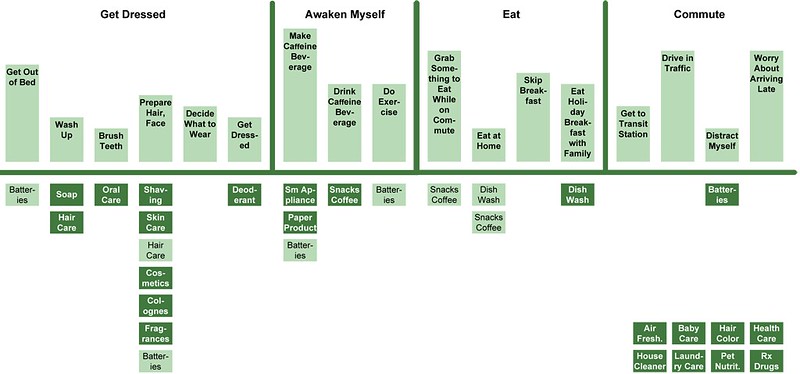
I began referring to the process as "task analysis" in 1993. I saw a lot of eyeballs rolled heavenward, though. Business stakeholders and peers who were doing the analysis all gave me the distinct impression that it implied too much work. So I got rid of the word "analysis" and, when I came up with the diagram in 2001, started calling it "mental model." People adopted it. There was much less eyeball movement heavenward.
However, the phrase "mental model" is overloaded with meaning. People from the world of cognitive psychology might take issue with what the process produces. Academics will take issue with the way I am defining it. My publisher wants to avoid arguments, so together with his board of advisors, we came up with the name "alignment diagrams." We hoped to emphasize how the diagram can be used.
I would like to hear from you. Should I continue to call it "mental model," and get ready for the arguments? Should I stick with "alignment diagram?" Or should I try one of the suggestions that I've heard? These are the names people are using for the process and the diagram within their own organizations:
- Content and Task Analysis Model
- Content Cognition Model
- Goal Mapping
- Goal Oriented Site Architecture
- Mental Map
- Task Model
Some people say I should keep the focus on the model itself. Others say the name should be broad enough to cover what comes after the creation of the model. A couple of people say the name should connote the human/creative side --the fact that it's a thought process, not a rigid, provable mathematical model.
And a whole bunch of people that I've worked with wonder why we can't just keep calling it "mental model."
Comments
"Alignment Diagrams" just *smacks* of Dilbert, though I agree with your discussion about "Mental Model". I personally like MM because it's short/sweet and I haven't heard it referred to in any other context. Of the options you propose above Goal Mapping and Mental Map are my faves. Again, short and sweet. Mapping also seems like a good description of the process I went through on our projects together. Hang tight...awesome work!
Posted by: Gina Davis | September 20, 2006 10:41 AM
I like the way "mental model" suggests that you are trying to understand the user's point of view, how they perceive the problem. That name makes sense to me. I don't have a background in cognitive psychology so that aspect doesn't bother me.
It's more readily understandable than "Alignment Diagrams" in my opinion, but I don't have an alternative suggestion. "User Perspective Diagrams"?
Posted by: David Poteet | September 20, 2006 10:46 AM
I really like "Content and Task Analysis Model" the best, since that I think most explains what it is the process is doing. Yes, it is a bit of a mouthfull, but it really is a good description.
"Task Model" would be my second favorite, followed by "Mental Model," though that stays on the list mostly from force of habit.
Posted by: Chiara | September 20, 2006 12:17 PM
I like "alignment diagram". Diagram sounds like it takes less time, so biz units will bite. "Alignment" indicates that it maps out where two concepts overlap, giving you a new perspective. But under any name, I'm looking forward to adding it to my toolkit.
Posted by: Tiff | September 20, 2006 01:06 PM
I am afraid the arguments would overshadow the good bits, so I'd suggest you adopt another name.
Goal Mapping rang a bell for me, maybe with "Content" thrown in somewhere (Goal Mapping for Content? or even Content Mapper?)
Posted by: Peter Boersma | September 20, 2006 01:32 PM
I really dislike "Alignment Diagram". It sounds so one-dimensional. I like Task Model. Mental Map would be the second choice.
If you use Mental Model, it wouldn't be the first time a term is used out of context of its original meaning.
Posted by: Sarah Rice | September 20, 2006 05:14 PM
As I have said earlier, I think you should stick to the term Mental Models. I posted about this issue on my blog here.
Posted by: rashmi | September 20, 2006 06:06 PM
Uh okay, I have a Masters Degree, and an enjoyment for academia, but when I read Alignment Diagrams, my reaction is *huh* *what*? Definitely do not understand what that means...which makes me feel dumb because now I think I *should* know what that means.
Now the subline of your title is really interesting because it's so *clear* as to what you are trying to do: Product Design for Real Life Activities. The language between the two has such a large disconnect. Alignment Diagrams: Product Design for Real Life Activities.
Mental Models is something that will capture your audience a little...more, which I'm assuming are folks in product management and design in corporations and not academia. I'm almost thinking you should name your book with the subline (or title) =). Just my 2 cents. I like that you've openend this up in a blog post. This is an awesome way to get feeddback.
Posted by: hollyster | September 21, 2006 09:21 AM
I like User Goals Model, or maybe User Goals Map, because they focus more on what the artifacts depict, and why / to what end. User Goals Model also identifies (at least partially) the people who are at the center of the exercise. [steps onto soapbox] Emphasizing the human element is something I think all of our artifacts would benefit from doing more often and more clearly. We could say that the presence of users is assumed / implied throughout the entire set of design artifacts - else why would we be doing all this work to understand their modes of understanding in the first place - but I think we should take every opportunity to remind anyone engaging with our design documents that they are concerned at root with people. [steps down from soapbox]
Posted by: joe lamantia | September 22, 2006 04:29 PM
I have never liked the term mental model for this - I certainly know that word to mean an entirely different thing. I think you will get criticism for using it, from the community who would be interested in the technique, and I don't think that's a great thing to happen.
It is task analysis, so that's not a bad place to start. But it is different because of the mapping/modelling part. I like 'content & task model' or 'mental map'
Posted by: Donna Maurer | September 22, 2006 08:33 PM
The term "mental model" is already quite widely used in a variety of areas related to social psychology and cognitive psychology. That could create quite a bit of confusion, especially since the most common tool for capturing mental models in those areas is typically some kind of "Concept Mapping" exercise.
I took a look at the diagrams you have in the "Cases" section of your website and I would offer the following compromise/hybrid title:
"Mental Alignment Diagramming"
I like this one because, shift from "Diagrams" to "Diagramming" emphasizes action, which is often a good marketing technique in choosing a title (grin).
Or, you could go the other way, with:
"Mental Alignment Models"
Posted by: David Morgan | September 29, 2006 01:54 PM
Thanks for all the input! I'm really torn between using and not using "mental model." It sounds like each one of you has a firm opinion, yet there is no overarching trend. Maybe it's one of those questions that needs to be un-asked, like in Zen philosophy. Maybe it's the wrong question. I'll have to think of it from a different angle.
Posted by: Indi Young | September 29, 2006 03:52 PM
I have been listening to my recently discovered podcasts from University of Berkely on iTunes and was listening to lectures on Psychology which was talking about definition of psychology that it's also a biological science, a physical science and so on.
With same intention, I think the term we choose for this should reflect the fundamental intent and not just how it is done today. Give this I keep lower emphasis to "Content and Task Analysis Model", "Content Cognition Model", "Goal Oriented Site Architecture" , and "Task Model". While these are also generic I think they still are tied to some degree how we handle the problem today.
"Goal Mapping" and "Mental Map" are more appropriate based on above argument, but Goal Mapping tends to indicate that it's only about user goal and Mental Map tends to give a more engineering kind of feel.
I would suggest sticking to Mental Model, as it is abstract enough to absorb future developments in methodologies and also what strikes with me when I talk about it is that it is a model that user has created (instinctively) in her head. It just works for me naturally.
I guess a long answer, but I was exploring as I was writing. Hope it makes sense.
Cheers
Alok Jain
Posted by: Alok Jain | September 29, 2006 04:00 PM
Mental Models and Alignment Diagrams are tools used in pursuit of a result: folding how users already think into your designs. The title of your book should reflect the result, not the tool. That's not just marketing; it's a statement of benefits. You want prospective readers to think, "This book will teach me to create designs that match how users already think? Sign me up!" Not, "Oh boy, a new kind of diagram!"
So here are some ideas: Designing the way People Think, Natural Design, Sites that Think Like You. Use "Alignment Diagrams" in a subtitle if you'd like.
Peter S.
Posted by: Peter Stahl | October 2, 2006 03:14 PM
"Oh boy, a new kind of diagram!" That made me laugh. You make a very good point, Peter. Thank you for shifting my perspective a little.
--indi
Posted by: indi young | October 2, 2006 03:58 PM
Indi: spatial constructs such as diagramming mental models suggest a title you may not like but it appeals to me:
A GPS FOR YOUR MIND - subtitle: Mental Models you can use to be more effective in life
Advice if free - and usually worth it!
Regards and good luck with your book.
BTW have you thought of releasing some or all of the book under a Creative Commons license that would allow your readers to select, remix and add value to your mental models? I am working with another author to explore this approach and would be happy to talk with you about it.
Posted by: dave davison | October 18, 2006 08:13 AM
I'm with Peter Stahl...imply the end result, not how it's attained. I really like his suggestion "Designing (for) the Way People Think", or something similar. Whatever you end up naming the "tool", keep it in a subtitle or somewhere less prominent, or don't even mention it. Even just using "Product Design for Real Life Activities" as hollyster suggested is a good start, though it makes me instinctively think of washing machines, fridges, and that kind of thing. ;-) I assume, though, that your scope is wider than just web sites?
The current title is definitely scary...and ironically, Alignment Diagrams makes it sound like it was chosen by a programmer, not an end-user. ;-) BTW, Mental Modeling is waaaay better than Task Analysis or many of the other suggestions, in my opinion. In the context of the world of software design, it's connotation is easily understood. The word "mental" is better than "task" because it implies thinking. The word "modeling" is better than "analysis" because it's more human (it has "heart") and implies molding/fashioning/creating/copying. Since you're trying to mimic the way people think, the term works. The fact that the term may be used in other disciplines shouldn't be a deterrent. In fact, it may help make the point.
I'm sure you'll do the right thing in the end!
Posted by: Paul Harman | October 18, 2006 02:57 PM
You are making sense. I like the word "model" because it's so much more descriptive. The idea of not having the model in the title, or at least only in the tag line, is beginning to really appeal to me.
And yes, my scope is wider than web sites. I'm hoping to pull together a model of how people use timers when jogging/running to demonstrate this. However, most of my examples end up as screen-based tools. And a watch has a screen, too, if you squint your eyes a little. ;) Hmm.
Posted by: indi young | October 18, 2006 03:30 PM
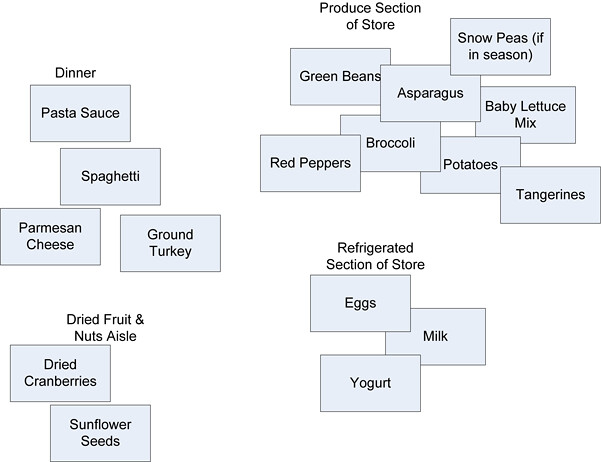
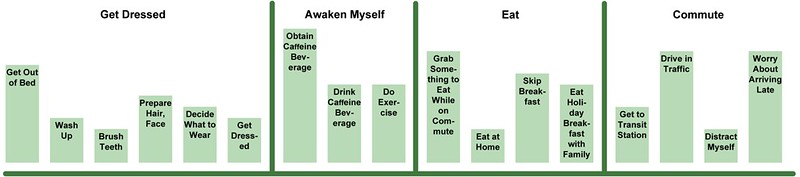
Dave, thanks for the advice! Good question about the Creative Commons license... since I'll be posting parts of the book here, I think that will be what Lou (my publisher) has in mind for available content. But I will ask him to chime in here about Creative Commons licenses... Lou? I know that our approach is all about getting as much writing, examples, and templates out there as possible. Already people are remixing the mental model itself. Just last night I was talking with Mary Piontkowski and John Belew about using the task data to drive workflow process evaluation. Mary is looking at combining the data across the x-axis to see what a particular set of people is doing. John is thinking about putting all the tasks in an XML data format. There is much more that can be done with the task data than just creating a mental model. Which, of course, makes me lean towards calling the technique something closer to task analysis, with one of the outputs being the mental model diagram. And then there's the separate question of the title for the book, which I'm thinking maybe doesn't need the name of the model in it at all, as people have been suggesting.
Posted by: indi young | October 23, 2006 02:37 PM
I've been using alignment diagrams for 3 years. I started out calling them mental models, after your work at Adaptive Path. That required a lot of explanation to clients, so I started calling them alignment models (they line up user tasks, site features and functions, and in some cases, business drivers). I was thrilled to see you come up with the same terminology - it makes talking with clients much easier for me.
Posted by: Jess McMullin | October 27, 2006 09:22 AM